

If I had to choose one single bio-marker that serves as a measure of my fitness levels, I would unhesitatingly choose VO2 Max. In this post I will explain why as well as briefly document my own journey over the last few months.
In early 2023, after my running hits and misses between 2021 and 2022, I took a break from running completely. I pretty much ate, drank and vegetated with very little, and sometimes, no exercise at all for weeks together.
I went for my annual physicals in August-September of 2023 and this included a graded test for determining my VO2 Max levels. Coupled with deterioration in a few other markers (as evidenced by other tests), my results came back with a score of 37, a new low.
I was shocked since I was used to being in the VO2 Max band of 48-50 and was expecting my score to be somewhere in the vicinity of 40-42.
It was a wake-up call that forced me to get out and start afresh. The goal was singular. In the 12 months between October 2023 and September 2024, I would work towards getting my VO2 Max back at their 2022 levels (which had peaked at 51 then).
Let me now segue to what VO2 Max is and the why and how of it.
DISCLAIMER: I AM NEITHER A TRAINED MEDICAL PROFESSIONAL NOR A FITNESS INFLUENCER. WHAT I HAVE WRITTEN BELOW IS EXCERPTED FROM MY OWN RESEARCH NOTES AND EXPERIENCE. PLEASE CONSULT YOUR OWN PERSONAL PHYSICIAN OR MEDICAL ADVISOR TO DETERMINE WHAT WORKS BEST FOR YOU. I ACCEPT NO RESPONSIBILITY FOR YOUR ACTIONS.
Disclaimers out of the way then!
VO2 Max is the single biggest indicator of cardio-respiratory fitness and aerobic endurance and more importantly, one’s lifespan.
Think of VO2 Max in humans as akin to the horsepower of an engine, the engine here being our bodies. A higher horsepower is an indicator of better performance
Simply stated, it is the maximum rate at which an individual can utilize oxygen during intense exercise and is a measure of the body’s capacity to transport and use oxygen during physical activity. VO2 Max is measured in milliliters (of oxygen consumed) per kilogram (of body weight) per minute – expressed as ml/kg/min.
It is affected by several factors including physical age, sex, genetics, body composition and training status. VO2 max generally declines with age and is higher in males as compared with females.
A higher VO2 Max is generally associated with a lower risk of cardiovascular disease, obesity and all-cause mortality.
The main components that contribute to an individual’s VO2 Max are (in no particular order):
Cardiac output, or volume of blood pumped by the heart per minute. A higher cardiac output allows more oxygen rich blood to be delivered to our muscles. Increased aerobic or cardio vascular activity over time improves cardiac output,
Pulmonary diffusion capacity, which is the ability of our lungs to transfer oxygen from the air into the blood. An efficient system ensures blood leaving the lungs is highly oxygenated,
Oxygen-carrying capacity of the blood, determined by the concentration of haemoglobin – the protein in our red blood cells that binds to oxygen. Higher the haemoglobin in our blood, more the oxygen delivery to our muscles. Consumption of iron-rich foods (red meat, spinach, green leafy vegetables, etc) and their effective absorption leads to better/improved haemoglobin levels in our blood,
Muscle capillary density (“MCD”), which means the number of capillaries surrounding the muscle fibres. A higher MCD facilitates better oxygen delivery. Studies on continual strength-endurance activities (think strength/weight training with lower weights at higher repetitions) have been shown to improve MCD,
Mitochondrial density, with a higher density allowing for greater oxygen utilisation by our muscles. Continual aerobic exercises help improve mitochondrial density over time, and
Muscle fibre composition: Type 1 muscle fibres, also known as slow-twitch muscle fibres use oxygen to produce energy and have a higher capacity for aerobic metabolism and being more fatigue resistant. Most muscles in the body contain a mix of both slow-twitch and fast-twitch fibers, with the proportion varying depending on the muscle’s primary function and the individual’s genetics and training history.
So, importantly, how do you measure your VO2 Max. Well, there are a few ways you can do this.
I personally recommend a good fitness tracker as a very good proxy measure. I have been using Garmin for over two decades now and am currently wearing a Fenix 7. Over time, I have found Garmin to be quite reliable. I back the numbers on my tracker up with a quarterly graded exercise test at a (running) clinic that has specific VO2 Max testing equipment.
Another option is an online calculator. There are several of them, just google search “online VO2 Max calculator”. These calculators typically require you to fill out the time you take to run 1 mile or 2.4 kilometres at an all out effort, providing for proper warm up and cool down procedures book-ending the actual test itself. You then fill in certain parameters (height, weight, age, etc) in the online form and you get your predictive VO2 Max. A good calculator can be found here and here.
The following images have been sourced from here (and subject to the creator’s copyright, as applicable). They are the VO2 Max indicative ranges by age and sex and I would encourage you to read the full article too!
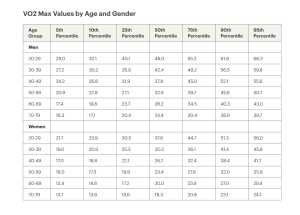
Coming back to my own story, I adopted a self-designed training protocol that I began in October 2023. With very little or no exceptions, I have been consistently following it for the last six months.
I ensure I run or walk anywhere between a minimum of 8,000-10,000 steps daily,
I run thrice a week – on Tuesdays (slow runs upto 6-8km distance at my Zone 2 HR pace, Thursdays (the Norwegian 4x4s for VO2 Max improvement) and Saturdays (long runs between 15-18km at my Zone 2 HR pace). Typically, the split is about 85:15 in favour of slow runs at my Zone 2 HR pace.
I have found the Norwegian 4×4 protocols to be the most effective for me. Essentially this involves starting with an easy 5-10 minute warmup at a tempo pace. The actual 4×4 involves running for 4 minutes at YOUR all-out maximum effort (measured by pace or speed) followed by 4 minutes of rest or walking at normal pace, repeated 4 times. You then cool down with 3-5 minutes of walking. It takes about 40-45 minutes to complete including the warmup and cool down timers.
I strength-condition and train my core, back and legs intensively twice weekly – weighted squats, leg extensions, dead lifts, farmer’s carries, etc to name a few exercises.
Most importantly, CONSISTENCY is key. I show up without fail for training.
My results are below. VO2 Max has improved in the last six months steadily and is now at 43. I am somewhere in the 80th-85th percentile now, up from the 50th-55th percentile in October 2023. A good improvement.
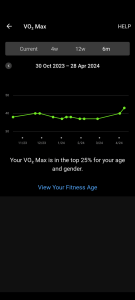
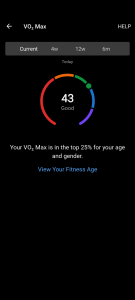
I need to get to the purple segment by September 2024 and maintain it at that level as sustainably as I can!
I also went to the online calculator I referred to above and self measured. Here’s what came out.
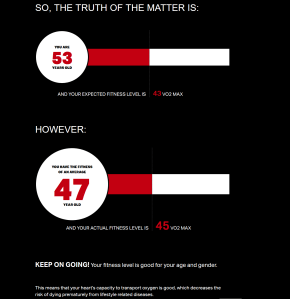
I appear to be progressing as expected to achieve my goal target of 48-50 by September 2024.
I will update progress on this very important bio-marker as it relates to my own fitness journey in later posts.
On an end note, I encourage you all to measure your own VO2 Max and look to improve it gradually. I promise you, it will be among the best gifts you can give yourselves. One that has immense potential to give you a bonus decade of life.
Thank you for reading. All the very best in your journey