

This post comes in response to a question I was asked recently – “what is your diet when you are training?”
The TLDR answer is none. To borrow from an adage, I don’t diet and exercise, I eat and train.
I am not one for dieting. Neither am I a gluttonous eater (at least these last few years). Over the years, I have followed a few principles that I learnt and adapted to suit my needs – during training and out of it.
Rather than speak about my daily menu, here are the main principles I follow around which my nutrition is based.
So, without further ado and in no particular order:
Principle 1: Know Your Body
Nutrition starts with knowing what the body needs, specifically YOUR body. I am diabetic and on oral medication. I consciously seek out foods that have a low glycemic index and a low glycemic load, lean meats and plentiful servings of vegetables and fruits (more v, less f though).
There is no one size fits all. I have learnt over the last few years – through reading, speaking with several people including sports doctors and nutritionists, googling and being my own lab rat among other methods – on what works for me.
The objective is simply to provide the right fuel for my training – an optimal mix of glycogen, protein, fats, minerals and vitamins.
Principle 2: Portion Size Matters
Over 2 decades ago, I was proud of one of my abilities – I could knock back 4-5 generous pours of alcohol, accompanied by 1-2 plates of meat starters, followed by a main course of 2-3 parathas eaten with a dish of chicken or mutton gravy and ending it with a dessert – usually icecream. And this was just dinner! Lunch was slightly lighter and minus the alcohol.
On some days, the hunger for Indian food was replaced by a hunger for Chinese food – egg noodles, the ubiquitously Indian style chicken manchurian, Sichuan chicken gravy, honey date pancakes and so forth!
I am sure you see the picture! I recently took a calorie count of one such binge dinner! Take a look:
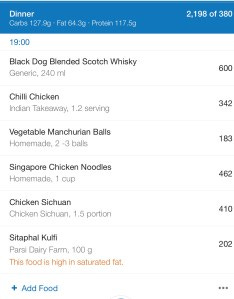
I just ate my whole day’s calorie intake (c2,000 calories) in one single meal. If I were to add up breakfast, lunch and my late afternoon snack, I would have added another 1,000 odd calories.
Not anymore! I stick with a weekly rotating menu that provides me with 1,600-1,700 calories of energy every day. It translates to about 150gms of carbs, 300-400gms of cooked chicken or fish and about 500-600gms of vegetables daily. When training, I aim for about 2,500-2,800 calories daily!
It is very important to be as mindful of what we put into our mouths as much as how much we put into our mouths.
I track my calorie intake using MyFitnessPal.
Principle 3: Eat Natural
Very easy to state, needs a discipline to practice.
I eat foxtail millets or red/brown rice for my glycogen. About 100-150gms of cooked worth daily. This ticks the box on carb intake.
I eat vegetables raw or steamed, almost always. This ensures their taste and nutrition is retained to a large extent. Carrots, beets, peppers, peas, cauliflower, beans, palak, methi, tomatoes and cucumbers are my staple vegetables. I boil potatoes (yes, it is a vegetable, not a carbohydrate)! Mushrooms are another year round favourite.
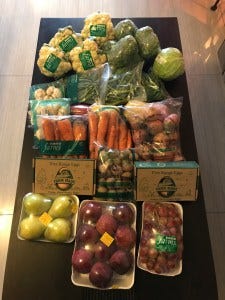
When in season, I eat lots of broccoli and Brussel sprouts.
I eat lots of boiled egg whites, fish (surmai, rawas, indian salmon, etc) and country fed chicken. I buy them from a fresh store and I marinate and cook the meats. That’s my protein intake. I usually avoid red meat and pork (exception: cheat days).
With the rare exception of marinating meat sparingly with a little salt, I eat almost salt free.
I believe the vegetables I eat contain all the vitamins, salts and trace minerals I need. So I use fresh lemons (lots), pepper, nutmeg, chilli flakes, cinnamon and turmeric as condiments.
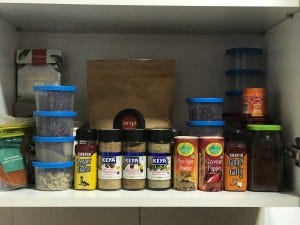
When I travel (which is a lot), the hotels I stay in have specific instructions on my eating preferences and tastes, so my food is almost always prepared to my palate!
Whilst not entirely raw, my eating habits today are almost atavistic. I completely advocate it.
And importantly, I avoid processed foods as much as I can. If it has more than 4-5 ingredients, I put it back on the supermarket shelf.
Principle 4: Cheat Days Are Important
I enjoy a good drink as much as the next person. And I have a sweet tooth. However, I do not indulge frequently.
Which is why Cheat Days are important. I usually have 1-2 cheat days a month. Where I drink well and eat rich.
This keeps my cravings in check and ensure I do not fall off the wagon.

I usually reserve these outings for weekend lunch. As I am an early sleeper-riser, I cannot afford to indulge late into the evening.
Principle 5: Hydrate Hydrate Hydrate
I drink about 1,500-1,800 mils of water daily (about 8-10 glasses worth). Usually flavoured with a freshly squeezed lemon or two.
This helps keep my pH in balance as well as help flush out toxins.
When running I drink about a litre of water every 10km. Keeps me from cramping or dehydrating.
Without sounding preachy, I tend to follow these practices for the most part.
Hope this was useful.
More later
S